

Published: December 16, 2025
Written by: J. L. Richards
For years I have struggled to organize the mess that is my writing folder and my writing projects spread across multiple tools.
No matter how many times I tried to clean it up, it always seemed to fall apart again.
New drafts would get started, old projects would get revisited, and suddenly there were files everywhere. Scrivener projects in one place. Word documents in another. Notes scattered across Google Docs. PDFs and exports that I vaguely remembered creating but could never find when I actually needed them.
What made it worse was that none of this felt dramatic in the moment. It was not one big failure or disaster.
It was small things piling up. Spending a few extra minutes searching for the right file.
Opening the wrong draft by accident. Forgetting what state, a project was in because I had not looked at it in months.
***
Over time, those small moments added up. They made starting feel heavier than it needed to be, and returning to older projects feel strangely intimidating, even when I still cared about them.
I tried a lot of different tools to fix this. Notion templates. Obsidian setups. Various systems that promised better organization if I just put in the time. Each one worked in its own way, and I do not regret trying them. But every time, I felt the same resistance.
They all asked me to build a system before I could actually use it.
When I sit down to write, I want to start writing. I do not want to spend an hour organizing things just to realize the system does not fit how my brain works.
So instead, I stopped worrying about having a perfect system. I named my files in a way that made them easier to search, accepted a little mess, and focused on just getting words down.
Scrivener handles that part beautifully, and it is still my favorite program for actually getting words on the page.
***
The real problem, however, kept creeping up on me. It was everything around the writing.
Most tools that claim they can manage writing projects either require a ton of upfront setup or expect you to manually add each book, folder, or document one by one.
That kind of process completely drains my energy.
For a long time, I kept thinking the problem was me.
That if I could just be more disciplined or more patient, one of these tools would eventually click. But the more projects I worked on, the worse it got.
The folder mess grew faster than I could keep up with it, and the friction of trying to manage everything made it harder to return to projects I actually cared about.
Managing manuscripts, drafts, PDFs, and documents across different writing tools slowly became its own kind of work.
I did not stop writing because of it, but I did start avoiding certain projects. The ones that felt too tangled. The ones I knew would take effort just to understand where I had left off.
***
At some point, I realized what I was really missing. I did not need another place to write. I needed a way to see everything I was already working on in one place, without moving files around or committing to yet another rigid system.
I wanted something that would simply look at my existing folders and files and say, here is what you have. Nothing more complicated than that.
Out of frustration more than ambition, I ended up building something small for myself. I was not trying to create a product. I was just trying to solve a problem that had been bothering me for years. That experiment eventually became Authors Toolbox.
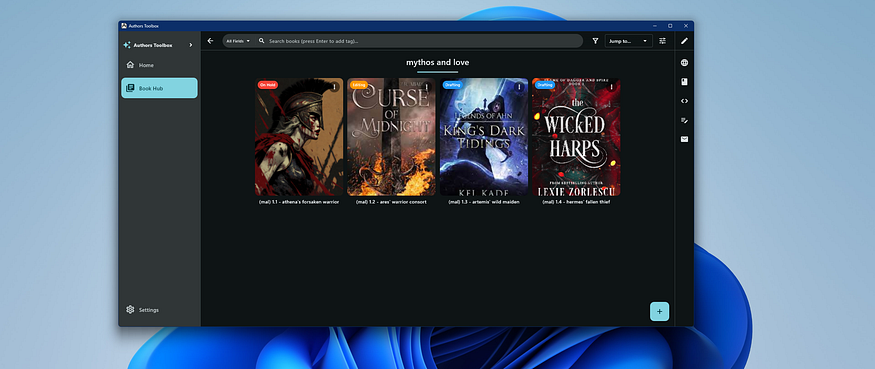
What mattered to me most was that it did not touch my files. It does not move them, rename them, or open them. It just imports them in bulk and gives me a visual way to see my projects. I can tell what is finished, what is in progress, and what is still sitting there waiting for attention.
For the first time, my writing felt visible instead of buried.
It did not magically make me more productive. It did not fix my procrastination or make writing easier. But it removed a layer of friction that had been quietly draining me for a long time.
For the first time in years, organizing my writing stopped feeling like something I had to fight. It became something that supported the work instead of getting in the way.
If you are curious, you can learn more about Authors Toolbox here.
